












 Bojan Veselinovikj |
June 30, 2026
Bojan Veselinovikj |
June 30, 2026


If you've spent any time mixing or mastering, you've likely encountered the debate around linear phase EQ vs normal EQ. Both are essential tools, but choosing the wrong one at the wrong moment can introduce unwanted artifacts or technical problems that are difficult to diagnose. Understanding the core differences between these two types of equalization isn't purely academic — it directly affects how your audio sounds and how tracks sit together in a mix.
In this guide, we'll break down what each type does, explore the pros and cons, and give you a clear picture of when to use linear phase EQ and when a regular EQ is the smarter call. Whether you're processing individual tracks or working across multiple tracks simultaneously, this knowledge will sharpen every decision you make at the EQ stage.

What Is A Normal (Minimum Phase) EQ?
A normal EQ — also called a minimum phase EQ — is the standard equalizer found in virtually every DAW and plugin collection. It follows the same design principles that governed analog equalizers long before digital audio existed. In fact, traditional EQ existed in hardware form for decades before it was ever modeled in software.
The defining characteristic of minimum phase equalization is that it introduces a phase shift alongside any gain change. When you boost or cut certain frequencies, the EQ also shifts the timing of those frequencies relative to others. This creates a phase relationship change across different frequencies in the signal — technically a form of phase distortion, though particular EQs harness this behavior to achieve their particular character and sonic identity.
A regular EQ or traditional EQ is fundamentally a nonlinear EQ in terms of phase behavior: the phase changes it introduces are tied to the specific frequencies being boosted or cut. It does not maintain a consistent phase delay across the spectrum. This is simply how analog equalizers have always operated, and in most mixing contexts, it is completely acceptable.
Pros And Cons Of Normal EQ
Pros:
Musical coloration: The phase changes inherent in analog equalizers are often musically desirable. This nonlinear phase behavior contributes warmth, body, and presence that engineers have relied on for decades. A regular EQ delivers a predictable equalization result with a familiar EQ response that most engineers understand intuitively.
Low CPU usage: A standard regular EQ uses minimal CPU power, making it practical across many individual tracks without straining your system — even in dense sessions.
Zero latency: Normal EQ requires no look-ahead processing, making it suitable for real-time use during tracking.
Cons:
Phase distortion at extremes: High gain boosts with narrow width settings, a massive treble boost, or an extreme low frequency setting can produce significant phase shift that colors the signal in unintended ways.
Phase cancellation risk: When combining bands or processing signals that share low frequencies — like a kick drum layered with bass — the phase distortion from a normal EQ can trigger phase cancellation when those signals are summed together across multiple tracks.
Nonlinear phase behavior: The nonlinear nature of a minimum phase EQ means it affects different frequencies with different timing shifts. This compounds when you're stacking EQ moves across multiple tracks in the same session.
What Is a Linear Phase EQ?

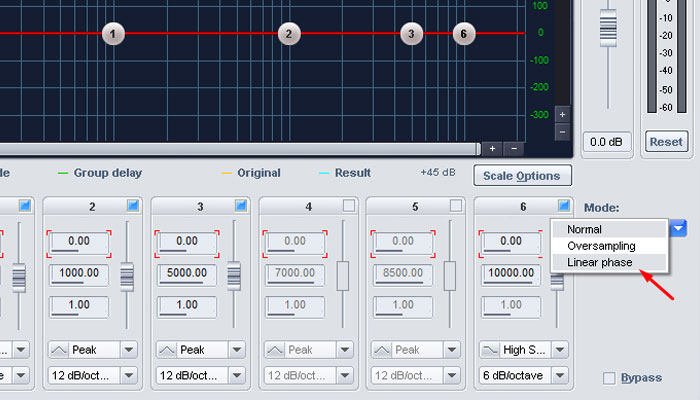
A linear phase EQ works very differently from a standard filter. Instead of processing audio in real time, the way minimum phase filters do, a linear phase equalizer applies its EQ settings through mathematical convolution — similar in principle to how convolution reverbs work.
The result is a linear phase response: every frequency is delayed by exactly the same amount, preserving the phase relationship between all components of the signal. There is no phase distortion introduced in the traditional sense. The appropriate EQ response you dial in is applied with complete transparency across the entire frequency spectrum.
However, linear phase operation is not without significant trade-offs. Linear phase EQ delays are inherent to the process: the algorithm requires look-ahead buffering, introducing latency that can be quite substantial. If your host recording software doesn't compensate for this properly, the processed audio will sound late compared to the rest of your session — a timing misalignment that has the same practical effect as a misadjusted audio interface parameter and can quietly ruin an otherwise clean mix.
There is also pre-ringing to contend with. Because the convolution filter works symmetrically in time, a slight ripple of energy appears before transient hits. This low-level pre-ringing is the fundamental trade-off of linear phase equalization. Pre-ringing prior to sharp attacks becomes more noticeable when using extreme settings, especially when steep filters are applied at relatively low frequencies — exactly where the artifact is most pronounced.
Pros And Cons Of Linear Phase EQ
Pros:
Phase accuracy: A linear phase EQ is built to preserve the phase relationship across the entire frequency spectrum, making it ideal for mastering and parallel processing.
Transparent sound: A linear EQ adds no coloration — just the appropriate EQ response you specify. Mastering engineers depend on this for predictable equalization on complete stereo mixes.
Parallel processing compatibility: When blending a dry signal with a processed audio version, the phase must remain consistent. A phase EQ with linear phase response ensures the two signals combine without phase cancellation — a critical advantage in any parallel processing setup.
Cons:
Pre-ringing: Even a low-level pre-artifact can smear transients and reduce impact. This low-level pre-ringing is especially problematic on kick drum or snare drum hits when steep filter curves are used.
High CPU demand: Linear phase equalizers require far more CPU power than a regular EQ, which can strain resource-heavy sessions considerably.
Latency: Linear phase EQ delays can be significant. If your host recording software fails to compensate for linear phase operation, the processed audio will sound late compared to all your other tracks — a problem that behaves just like a misadjusted audio interface parameter in how it throws off your session timing.
Linear Phase EQ Vs Normal EQ: Main Differences
The fundamental distinction between these two tools comes down to phase behavior. A minimum phase EQ introduces nonlinear phase characteristics: different frequencies are delayed by different amounts as they pass through the filter. A linear phase EQ maintains a flat line of consistent phase offset across the spectrum, treating all frequencies identically in terms of timing.
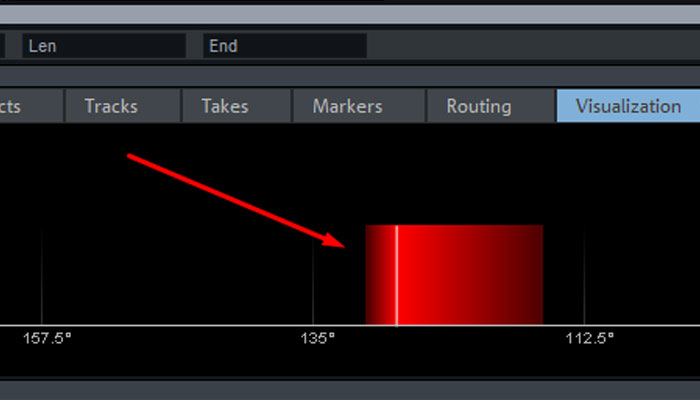
In practice, a normal EQ boost at the cutoff frequency changes amplitude and shifts the phase of that region, producing a wavy line on a phase analyzer rather than a neutral response. A linear phase EQ delivers the same amplitude change while keeping the phase plot as a flat line.
A nonlinear EQ accumulates phase changes cumulatively — a problem that compounds when combining bands or processing multiple tracks that interact at relatively low frequencies. A linear EQ avoids those phase issues but introduces linear phase EQ delays and pre-ringing that need to be managed carefully.
The sonic difference is most noticeable at relatively low frequencies, during extreme moves with high gain EQ settings, or when summing multiple tracks that have been processed independently with different EQ settings applied to each.
Linear Phase EQ vs. Normal EQ (Core Differences) Table Of Contents
| Feature | Normal (Minimum Phase) EQ | Linear Phase EQ |
|---|---|---|
| Phase behavior | Nonlinear | Linear |
| Phase shift | Yes | No |
| Phase distortion | Yes | No |
| Pre ringing | No | Yes |
| CPU usage | Low | High |
| Latency | Minimal | Significant |
| EQ mode | Individual tracks, mixing | Mastering, bus processing |
| Coloration | Adds character | Fully transparent |
| Parallel processing | Limited | Excellent |
When to Use Linear Phase EQ and Normal EQ
Use Linear Phase EQ When:
Mastering: Mastering engineers work with complete stereo mixes where even subtle phase distortion can alter the phase relationship between elements already baked into the final bounce. A linear phase response keeps the processed audio transparent and uncolored throughout.
Parallel processing: When blending a dry signal with an EQ'd version, phase changes from a minimum phase EQ can trigger phase cancellation when the signals are combined. A linear EQ prevents this entirely — one of the strongest reasons to use linear phase EQ in creative processing chains.
Stereo bus processing: Applying linear phase equalization on your stereo bus avoids phase issues that could smear your stereo image or reduce punch across all your other tracks.
Gentle moves on full mixes: With wide-band EQ settings applied subtly, pre-ringing stays inaudible. It becomes a real concern at extreme settings with steep filters targeting low frequencies.
Use Normal (Minimum Phase) EQ when:
Individual tracks: On a kick drum, snare drum, vocals, or guitars, the phase shift of a regular EQ is musically acceptable — often beneficial. Only traditional EQ delivers the particular character of analog equalizers, and that authentic coloration is frequently exactly what the track needs.
Surgical EQ: Precise narrow width settings cuts to remove resonances — surgical EQ work — are faster and far less CPU-intensive than a normal EQ. There's rarely a reason to invoke linear phase mode for this kind of job.
Real-time tracking: Linear phase EQ delays make linear phase operation impractical during live recording. Normal EQ is the only sensible EQ mode in this context.
Low-end shaping on sources: Pre-ringing is most pronounced at relatively low frequencies, but the phase distortion of a minimum phase EQ at those same frequencies is often inaudible on individual tracks. A regular EQ is perfectly fine for sculpting low frequencies on sources.
Practical example: Imagine you're working on a drum kit. You've placed a kick drum in the center with overhead mics capturing the snare drum and cymbals. Apply aggressive EQ to the kick drum using linear phase mode, and the pre-ringing may make your same kick feel undefined at the attack — the kick appears clipped or blurred before the hit even lands. Switch to standard EQ mode, and that same kick snaps back to sounding punchy and defined. But on the stereo bus where the kick drum, snare drum, and all your other tracks must maintain their phase relationship with each other, linear phase equalization is the cleaner, more reliable choice.
Final Words
The linear phase EQ vs. normal EQ debate has no universal winner. Only traditional EQ makes sense for tracking, real-time processing, and most mixing tasks on individual tracks. Linear phase equalizers earn their place in mastering chains, stereo bus work, and parallel processing rigs where phase coherence is essential.
Understanding why each behaves differently is what sharpens your decision-making. A minimum phase EQ trades phase accuracy for musical coloration and near-zero latency. A linear phase EQ trades pre-ringing and heavier CPU power demands for completely transparent, predictable equalization. Know your EQ mode, know your context, and your mixes will reflect that care.
FAQ
Is linear phase EQ better than normal EQ?
Not necessarily. Linear phase EQ preserves phase relationships and avoids phase distortion, making it useful for mastering and parallel processing. However, it introduces latency, uses more CPU, and can create pre-ringing artifacts. Normal (minimum phase) EQ is more efficient, adds less latency, and is often preferred for individual tracks and general mixing. The better choice depends on the specific application rather than one being universally superior.